
Tags
Language
Tags
June 2026
Su Mo Tu We Th Fr Sa
31 1 2 3 4 5 6
7 8 9 10 11 12 13
14 15 16 17 18 19 20
21 22 23 24 25 26 27
28 29 30 1 2 3 4
    Attention❗ To save your time, in order to download anything on this site, you must be registered 👉 HERE. If you do not have a registration yet, it is better to do it right away. ✌

    ( • )( • ) ( ͡⚆ ͜ʖ ͡⚆ ) (‿ˠ‿)
    SpicyMags.xyz

    Trending now in eBooks & eLearning


    Statistical Properties of Deterministic Systems (Repost)

    Posted By: AvaxGenius
    Statistical Properties of Deterministic Systems (Repost)

    Statistical Properties of Deterministic Systems by Jiu Ding , Aihui Zhou
    English | PDF(True) | 2009 | 248 Pages | ISBN : 3540853669 | 1.8 MB

    Part of Tsinghua University Texts, "Statistical Properties of Deterministic Systems" discusses the fundamental theory and computational methods of the statistical properties of deterministic discrete dynamical systems. After introducing some basic results from ergodic theory, two problems related to the dynamical system are studied: first the existence of absolute continuous invariant measures, and then their computation. They correspond to the functional analysis and numerical analysis of the Frobenius-Perron operator associated with the dynamical system.

    Hierarchical and Geometrical Methods in Scientific Visualization

    Posted By: AvaxGenius
    Hierarchical and Geometrical Methods in Scientific Visualization

    Hierarchical and Geometrical Methods in Scientific Visualization by Gerald Farin, Bernd Hamann, Hans Hagen
    English | PDF (True) | 2003 | 363 Pages | ISBN : 3540433139 | 48.9 MB

    The nature of the physical Universe has been increasingly better understood in recent years, and cosmological concepts have undergone a rapid evolution (see, e.g., [11], [2],or [5]).

    Nigel J. Kalton Selecta: Volume 2 (Repost)

    Posted By: AvaxGenius
    Nigel J. Kalton Selecta: Volume 2 (Repost)

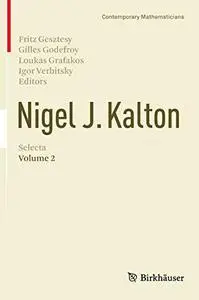
    Nigel J. Kalton Selecta: Volume 2 by Fritz Gesztesy, Gilles Godefroy, Loukas Grafakos, Igor Verbitsky
    English | PDF (True | 2016 | 778 Pages | ISBN : 3319187988 | 262.5 MB

    This is the second part of a two volume anthology comprising a selection of 49 articles that illustrate the depth, breadth and scope of Nigel Kalton’s research. Each article is accompanied by comments from an expert on the respective topic, which serves to situate the article in its proper context, to successfully link past, present and hopefully future developments of the theory and to help readers grasp the extent of Kalton’s accomplishments. Kalton’s work represents a bridge to the mathematics of tomorrow, and this book will help readers to cross it.

    Nigel J. Kalton Selecta: Volume 2 (Repost)

    Posted By: AvaxGenius
    Nigel J. Kalton Selecta: Volume 2 (Repost)

    Nigel J. Kalton Selecta: Volume 2 by Fritz Gesztesy, Gilles Godefroy, Loukas Grafakos, Igor Verbitsky
    English | PDF (True | 2016 | 778 Pages | ISBN : 3319187988 | 262.5 MB

    This is the second part of a two volume anthology comprising a selection of 49 articles that illustrate the depth, breadth and scope of Nigel Kalton’s research. Each article is accompanied by comments from an expert on the respective topic, which serves to situate the article in its proper context, to successfully link past, present and hopefully future developments of the theory and to help readers grasp the extent of Kalton’s accomplishments. Kalton’s work represents a bridge to the mathematics of tomorrow, and this book will help readers to cross it.

    Cryptographic Applications of Analytic Number Theory: Complexity Lower Bounds and Pseudorandomness

    Posted By: AvaxGenius
    Cryptographic Applications of Analytic Number Theory: Complexity Lower Bounds and Pseudorandomness

    Cryptographic Applications of Analytic Number Theory: Complexity Lower Bounds and Pseudorandomness by Igor Shparlinski
    English | PDF | 2003 | 402 Pages | ISBN : 3764366540 | 28.5 MB

    The book introduces new techniques that imply rigorous lower bounds on the com­ plexity of some number-theoretic and cryptographic problems. It also establishes certain attractive pseudorandom properties of various cryptographic primitives. These methods and techniques are based on bounds of character sums and num­ bers of solutions of some polynomial equations over finite fields and residue rings. Other number theoretic techniques such as sieve methods and lattice reduction algorithms are used as well. The book also contains a number of open problems and proposals for further research. The emphasis is on obtaining unconditional rigorously proved statements. The bright side of this approach is that the results do not depend on any assumptions or conjectures. On the downside, the results are much weaker than those which are widely believed to be true. We obtain several lower bounds, exponential in terms of logp, on the degrees and orders of o polynomials; o algebraic functions; o Boolean functions; o linear recurrence sequences; coinciding with values of the discrete logarithm modulo a prime p at sufficiently many points (the number of points can be as small as pI/2+O:). These functions are considered over the residue ring modulo p and over the residue ring modulo an arbitrary divisor d of p - 1. The case of d = 2 is of special interest since it corresponds to the representation of the rightmost bit of the discrete logarithm and defines whether the argument is a quadratic residue.

    The Theory of Pseudo-rigid Bodies

    Posted By: AvaxGenius
    The Theory of Pseudo-rigid Bodies

    The Theory of Pseudo-rigid Bodies by Harley Cohen , Robert G. Muncaster
    English | PDF | 1988 | 194 Pages | ISBN : 0387966358 | 14.6 MB

    This monograph concerns the development, analysis, and application of the theory of pseudo-rigid bodies. It collects together our work on that subject over the last five years. While some results have appeared else­ where, much of the work is new. Our objective in writing this mono­ graph has been to present a new theory of the deformation of bodies, one that has not only a firm theoretical basis, but also the simplicity to serve as an effective tool in practical problems. Consequently, the main body of the treatise is a multifaceted development of the theory, from foundations to explicit solutions to linearizations to methods of approximation. The fact that this variety of aspects, each examined in considerable detail, can be collected together in a single, unified treat­ ment gives this theory an elegance that we feel sets it apart from many others. While our goal has always been to give a complete treatment of the theory as it now stands, the work here is not meant to be definitive. Theories are not entities that appear suddenly one day and thereafter stand as given. Rather, they must mature and grow with time and experience. Our development is more correctly a beginning, tempting others to explore, appraise, and modify its features so as to produce something better.

    Encyclopedia of Algorithms

    Posted By: AvaxGenius
    Encyclopedia of Algorithms

    Encyclopedia of Algorithms by Ming-Yang Kao
    English | PDF(True) | 2008 | 1200 Pages | ISBN : 0387301623 | 19.8 MB

    The Encyclopedia of Algorithms will provide a comprehensive set of solutions to important algorithmic problems for students and researchers interested in quickly locating useful information. The first edition of the reference will focus on high-impact solutions from the most recent decade; later editions will widen the scope of the work.

    Conjugate Duality and the Exponential Fourier Spectrum

    Posted By: AvaxGenius
    Conjugate Duality and the Exponential Fourier Spectrum

    Conjugate Duality and the Exponential Fourier Spectrum by Wray Britton
    English | PDF | 1983 | 234 Pages | ISBN : 0387908269 | 11.9 MB

    For some fields such as econometrics (Shore, 1980), oil prospecting (Claerbout, 1976), speech recognition (Levinson and Lieberman, 1981), satellite monitoring (Lavergnat et al., 1980), epilepsy diagnosis (Gersch and Tharp, 1977), and plasma physics (Bloomfield, 1976), there is a need to obtain an estimate of the spectral density (when it exists) in order to gain at least a crude understanding of the frequency content of time series data. An outstanding tutorial on the classical problem of spectral density estimation is given by Kay and Marple (1981). For an excellent collection of fundamental papers dealing with modern spec­ tral density estimation as well as an extensive bibliography on other fields of application, see Childers (1978). To devise a high-performance sample spectral density estimator, one must develop a rational basis for its construction, provide a feasible algorithm, and demonstrate its performance with respect to prescribed criteria. An algorithm is certainly feasible if it can be implemented on a computer, possesses computational efficiency (as measured by compu­ tational complexity analysis), and exhibits numerical stability. An estimator shows high performance if it is insensitive to violations of its underlying assumptions (i.e., robust), consistently shows excellent frequency resolutipn under realistic sample sizes and signal-to-noise power ratios, possesses a demonstrable numerical rate of convergence to the true population spectral density, and/or enjoys demonstrable asymp­ totic statistical properties such as consistency and efficiency.

    Nigel J. Kalton Selecta: Volume 2 (Repost)

    Posted By: AvaxGenius
    Nigel J. Kalton Selecta: Volume 2 (Repost)

    Nigel J. Kalton Selecta: Volume 2 by Fritz Gesztesy, Gilles Godefroy, Loukas Grafakos, Igor Verbitsky
    English | PDF (True | 2016 | 778 Pages | ISBN : 3319187988 | 262.5 MB

    This is the second part of a two volume anthology comprising a selection of 49 articles that illustrate the depth, breadth and scope of Nigel Kalton’s research. Each article is accompanied by comments from an expert on the respective topic, which serves to situate the article in its proper context, to successfully link past, present and hopefully future developments of the theory and to help readers grasp the extent of Kalton’s accomplishments. Kalton’s work represents a bridge to the mathematics of tomorrow, and this book will help readers to cross it.

    Cyber Espionage and National Security Challenges

    Posted By: ELK1nG
    Cyber Espionage and National Security Challenges

    Cyber Espionage and National Security Challenges
    English | 2026 | ISBN: 978-3-032-09423-0 | 190 Pages | EPUB PDF (True) | 13.3 MB

    Algorithms for Parallel Processing

    Posted By: AvaxGenius
    Algorithms for Parallel Processing

    Algorithms for Parallel Processing by Michael T. Heath, Abhiram Ranade, Robert S. Schreiber
    English | PDF (True) | 1999 | 373 Pages | ISBN : 0387986804 | 40.5 MB

    This IMA Volume in Mathematics and its Applications ALGORITHMS FOR PARALLEL PROCESSING is based on the proceedings of a workshop that was an integral part of the 1996-97 IMA program on "MATHEMATICS IN HIGH-PERFORMANCE COMPUTING. " The workshop brought together algorithm developers from theory, combinatorics, and scientific computing. The topics ranged over models, linear algebra, sorting, randomization, and graph algorithms and their analysis. We thank Michael T. Heath of University of lllinois at Urbana (Com­ puter Science), Abhiram Ranade of the Indian Institute of Technology (Computer Science and Engineering), and Robert S. Schreiber of Hewlett­ Packard Laboratories for their excellent work in organizing the workshop and editing the proceedings. We also take this opportunity to thank the National Science Founda­ tion (NSF) and the Army Research Office (ARO), whose financial support made the workshop possible. A vner Friedman Robert Gulliver v PREFACE The Workshop on Algorithms for Parallel Processing was held at the IMA September 16 - 20, 1996; it was the first workshop of the IMA year dedicated to the mathematics of high performance computing. The work­ shop organizers were Abhiram Ranade of The Indian Institute of Tech­ nology, Bombay, Michael Heath of the University of Illinois, and Robert Schreiber of Hewlett Packard Laboratories. Our idea was to bring together researchers who do innovative, exciting, parallel algorithms research on a wide range of topics, and by sharing insights, problems, tools, and methods to learn something of value from one another.

    Nigel J. Kalton Selecta: Volume 2 (Repost)

    Posted By: AvaxGenius
    Nigel J. Kalton Selecta: Volume 2 (Repost)

    Nigel J. Kalton Selecta: Volume 2 by Fritz Gesztesy, Gilles Godefroy, Loukas Grafakos, Igor Verbitsky
    English | PDF (True | 2016 | 778 Pages | ISBN : 3319187988 | 262.5 MB

    This is the second part of a two volume anthology comprising a selection of 49 articles that illustrate the depth, breadth and scope of Nigel Kalton’s research. Each article is accompanied by comments from an expert on the respective topic, which serves to situate the article in its proper context, to successfully link past, present and hopefully future developments of the theory and to help readers grasp the extent of Kalton’s accomplishments. Kalton’s work represents a bridge to the mathematics of tomorrow, and this book will help readers to cross it.

    Probability with Statistical Applications (Repost)

    Posted By: AvaxGenius
    Probability with Statistical Applications (Repost)

    Probability with Statistical Applications by Rinaldo B. Schinazi
    English | PDF (True) | 2012 | 349 Pages | ISBN : 081768249X | 2.4 MB

    This second edition of Probability With Statistical Applications offers a practical introduction to probability for undergraduates at all levels with different backgrounds and views towards applications. Calculus is a prerequisite for understanding the basic concepts, however the book is written with a sensitivity to students’ common difficulties with calculus that does not obscure the thorough treatment of the probability content. The first six chapters of this text neatly and concisely cover the material traditionally required by most undergraduate programs for a first course in probability.

    Nigel J. Kalton Selecta: Volume 2 (Repost)

    Posted By: AvaxGenius
    Nigel J. Kalton Selecta: Volume 2 (Repost)

    Nigel J. Kalton Selecta: Volume 2 by Fritz Gesztesy, Gilles Godefroy, Loukas Grafakos, Igor Verbitsky
    English | PDF (True | 2016 | 778 Pages | ISBN : 3319187988 | 262.5 MB

    This is the second part of a two volume anthology comprising a selection of 49 articles that illustrate the depth, breadth and scope of Nigel Kalton’s research. Each article is accompanied by comments from an expert on the respective topic, which serves to situate the article in its proper context, to successfully link past, present and hopefully future developments of the theory and to help readers grasp the extent of Kalton’s accomplishments. Kalton’s work represents a bridge to the mathematics of tomorrow, and this book will help readers to cross it.

    Nigel J. Kalton Selecta: Volume 2 (Repost)

    Posted By: AvaxGenius
    Nigel J. Kalton Selecta: Volume 2 (Repost)

    Nigel J. Kalton Selecta: Volume 2 by Fritz Gesztesy, Gilles Godefroy, Loukas Grafakos, Igor Verbitsky
    English | PDF (True | 2016 | 778 Pages | ISBN : 3319187988 | 262.5 MB

    This is the second part of a two volume anthology comprising a selection of 49 articles that illustrate the depth, breadth and scope of Nigel Kalton’s research. Each article is accompanied by comments from an expert on the respective topic, which serves to situate the article in its proper context, to successfully link past, present and hopefully future developments of the theory and to help readers grasp the extent of Kalton’s accomplishments. Kalton’s work represents a bridge to the mathematics of tomorrow, and this book will help readers to cross it.